

Paramedics ambulance ertriage

How ERTRIAGE® Supports Pre-Hospital Emergency Services

In emergency medicine, the minutes before a patient reaches the hospital matter as much as the minutes after. The ambulance call, the time to scene, the on-scene care, and the handover to the emergency department together form the pre-hospital interval — and every stage of it can either add to a patient’s outcome or take from it. Pre-hospital teams do extraordinary work under pressure, but they often work without the tools to coordinate those stages as a single, optimised process. That is the gap ERTRIAGE® is designed to close.

In this article we explain how the ERTRIAGE® framework extends beyond the emergency department (ED) into the pre-hospital phase, what it does at each stage, and why this integration produces faster, safer, and more predictable emergency care.

Why the Pre-Hospital Phase Matters

Three specific problems limit pre-hospital care today:

  • Uncoordinated ambulance-to-ED handovers. The receiving emergency department often learns about a patient only when they arrive at the door — minutes that could have been used to pre-position staff and equipment are lost.
  • Under-triage during field assessment. When severity is assessed manually under time pressure, critically ill patients can be assigned a lower acuity than their condition warrants, delaying life-saving care.
  • Inefficient resource allocation. Without a structured view of the whole pre-hospital timeline, ambulances are dispatched on rules that consider one stage at a time, not the complete care pathway.

Each of these contributes to preventable delays, avoidable complications, and — in time-critical conditions like stroke, myocardial infarction, or major trauma — worse outcomes. The pre-hospital extension of ERTRIAGE® addresses all three through a single integrated framework.

The Three Pre-Hospital Stages ERTRIAGE® Coordinates

The pre-hospital interval is not one event; it is a sequence of three clinically distinct activities, each with its own time pressures and safety requirements.

1. Home-to-Scene (Dispatch and Mobilisation)

From the moment the emergency call is received to the moment the ambulance reaches the patient’s location. ERTRIAGE® uses real-time GPS telematics to calculate optimal routing and estimates the arrival window with accuracy that improves dynamically as traffic conditions change.

2. On-Scene Stabilisation

From arrival at scene to readiness for transport. This stage cannot be rushed arbitrarily — minimum times for airway management, spinal immobilisation, intravenous access, and other interventions are part of safe clinical care. ERTRIAGE® enforces these minimums as explicit safety constraints.

3. Scene-to-ED Transport

From ambulance departure to handover at the receiving emergency department. During this stage ERTRIAGE® continuously monitors the patient’s physiology through connected wearables and streaming vital signs, updating acuity and route priority in real time.

Coordinating all three stages together — rather than optimising one at a time — is what distinguishes an integrated pre-hospital framework from traditional dispatch tools.

How ERTRIAGE® Works Before the Hospital

Once the emergency call is received, ERTRIAGE® activates an autonomous Dispatch Agent and a Pre-Hospital Triage Agent that work together from call to handover. Their role is to plan, monitor, and communicate — while the paramedics on scene remain the clinical decision-makers.

1. Intelligent Dispatch with Clinical Safety Built In

When a call is received, ERTRIAGE® solves a scheduling problem that balances three goals: reaching the patient as quickly as possible, allowing enough on-scene time for safe stabilisation, and arriving at the right emergency department at the right time. Five safety rules are applied automatically:

  • Activity duration bounds — each stage has a minimum safe time and a maximum protocol limit.
  • Activity sequencing — no stage can begin before the previous one has completed.
  • Completion deadlines — every stage must be finished before its clinical hard deadline.
  • Resource bounds — only crews and vehicles that meet the call’s minimum requirements can be assigned.
  • Non-negativity — a sanity check that all times and allocations are operationally valid.

These rules ensure ERTRIAGE® never recommends a faster-but-unsafe dispatch. When resources are not sufficient for the situation — as in a mass casualty incident — the system flags the deficit clearly and triggers the mutual aid protocol, rather than attempting a dispatch that cannot succeed.

2. Continuous Acuity Prediction En-Route

On the way to the ED, patients can deteriorate — or improve. ERTRIAGE® does not wait until arrival to reassess. A validated early-warning scoring approach (NEWS2) runs continuously on streaming vital signs from the ambulance’s monitoring equipment. If the patient’s NEWS2 score rises above a critical threshold, ERTRIAGE® automatically tightens the on-scene time limits, re-prioritises the transport route, and alerts the receiving ED within roughly 90 seconds.

For suspected cardiac cases, the framework continuously interprets the 3-lead ECG stream and integrates the result into the established HEART assessment. When a significant ST-segment deviation is detected — consistent with a possible STEMI — the system generates an immediate pre-alert to the receiving cardiac catheterisation team, so the patient can bypass standard triage queuing on arrival.

3. A Structured Pre-Alert the ED Can Act On

Before the patient physically arrives, ERTRIAGE® transmits a structured pre-alert to the receiving ED. The pre-alert is written in HL7 FHIR R4 — an international health-data standard — so it is machine-readable by any compliant hospital information system, not only by ERTRIAGE® installations. Each pre-alert contains:

  • Patient demographics and call context.
  • Current vital signs with NEWS2 scoring (heart rate, oxygen saturation, blood pressure, respiratory rate, consciousness level).
  • The presenting complaint coded to international clinical vocabulary (ICPC-2), together with the AI-predicted Emergency Severity Index (ESI) level and a confidence score.
  • The Dispatch Agent’s scheduled times for scene arrival, departure, and ED arrival, with the crew and equipment assigned.

If the AI’s confidence in its prediction is below a safety threshold, the prediction is flagged for a clinician to review before the pre-alert is transmitted. This human-in-the-loop design ensures no unvalidated acuity reaches the ED autonomously.

What This Means Operationally

In retrospective NIMTS Hospital records comparing a period before and after ERTRIAGE® pre-hospital integration, the door-to-triage time for ambulance arrivals dropped from 3.4 minutes to approximately 2.58 minutes — a 24% reduction, comfortably within the American College of Emergency Physicians (ACEP) 5-minute benchmark. Under-triage of arriving patients fell from 6.0% to 3.3%. Even at mass casualty surge conditions — twelve concurrent critical calls — the constraint framework correctly identified resource deficits and activated mutual aid, rather than attempting unsafe dispatches.

These are observational results from an initial deployment and should be interpreted as operational context rather than clinical proof. They do, however, confirm that the framework behaves as specified in real-world conditions, and they justify moving forward with prospective field evaluation.

Why an Integrated Pre-Hospital and ED System Matters

The hospital emergency department is not the start of emergency care — it is the continuation of care that began the moment the emergency call was placed. When the ambulance and the ED operate as separate information systems, the handover is a cliff: the patient arrives, and the receiving team starts over. When they operate as an integrated system, the handover is a bridge: the receiving team already knows who is arriving, what happened, how the patient’s physiology has evolved, and what resources need to be ready.

ERTRIAGE® is designed to be that bridge. Its pre-hospital module extends the same clinical safety logic, the same acuity scale, and the same data standards that run at the ED triage desk out into the ambulance — so the first clinician who sees the patient in the hospital is already working with information the pre-hospital team has been collecting all along.

The Use Cases Where This Matters Most

Integrated pre-hospital support has particularly clear value in four settings:

  • Time-critical cardiac and stroke pathways, where door-to-treatment time is a direct predictor of outcome.
  • Major trauma, where early notification lets trauma teams pre-position surgical and imaging resources.
  • Mass casualty and disaster response, where structured dispatch with mutual-aid escalation is the difference between coordinated response and overwhelmed ambulance services.
  • Resource-constrained and non-metropolitan EMS, where every available ambulance hour is precious and scheduling inefficiencies translate directly into patient risk.

Conclusion

Pre-hospital care has historically been the most experienced and the least instrumented phase of emergency medicine. Paramedics and ambulance crews have carried the clinical judgment, but they have not always had systems that give them coordinated dispatch planning, continuous acuity tracking, and structured ED pre-alert in one integrated workflow. ERTRIAGE® brings all three together — not to replace clinical expertise, but to equip it.

When dispatch is optimised, when acuity is tracked continuously from the moment of first contact, and when the ED knows who is coming before the ambulance door opens, the emergency care pathway works the way it is supposed to: as one continuous system, not a series of disconnected stages. That is the difference ERTRIAGE® is built to make — in the hospital, in the ambulance, and in every minute in between.

DALL·E 2024-11-14 15.30.25 - A busy hospital emergency department with doctors, nurses, and patients in a modern setting. The scene shows healthcare professionals using digital ta

How ERTriage is Transforming Hospital Operations and Patient Care

Every Hospital worldwide face increasing pressure to provide high-quality care while maintaining operational efficiency. ERTriage, an AI-powered triage system, is at the forefront of addressing this challenge . By integrating real-time patient assessments and AI-driven decision support, ERTriage is reshaping how hospitals manage patient flow, reduce wait times, and optimize resource allocation.

Let’s see how ERTriage is helping hospitals improve operational efficiency, enhance patient care, and reduce costs.

1. AI-Driven Triage for Faster, More Accurate Patient Assessment

Traditionally, triage systems in hospitals rely on manual processes, leading to bottlenecks and potential delays in care. ERTriage revolutionizes this by leveraging artificial intelligence to assess patient symptoms quickly and accurately. The system collects patient data through digital interfaces, processes it in real time, and provides an initial diagnosis or categorization based on the severity of the symptoms.

This AI-driven approach allows hospitals to:

  • Prioritize critical cases, ensuring faster treatment for those in urgent need.
  • Reduce human error by providing consistent, evidence-based decision support.
  • Decrease wait times for patients, improving overall hospital efficiency and patient satisfaction.

2. Optimizing Hospital Resources and Reducing Operational Costs

Hospitals operate under tight budget constraints, and managing resources efficiently is a constant challenge. ERTriage can optimize hospital resource allocation by streamlining the triage process and reducing unnecessary patient visits.

Key benefits include:

  • Efficient Bed Utilization: By accurately assessing patients’ needs, ERTriage helps hospitals avoid overcrowding and ensures that beds are allocated to those with the most urgent medical conditions.
  • Staff Efficiency: Nurses and doctors spend less time on initial patient assessments, allowing them to focus on critical care tasks and improving overall workflow efficiency.
  • Cost Savings: With faster, more accurate triage and resource optimization, hospitals can reduce the costs associated with patient mismanagement and unnecessary treatments.

3. Enhancing Patient Experience and Reducing Overcrowding

Patient satisfaction is directly tied to how quickly and effectively they receive care. ERTriage enhances the patient experience by providing an immediate, accurate assessment, allowing patients to know the urgency of their condition without waiting long hours.

By reducing unnecessary hospital visits and streamlining the triage process, ERTriage helps hospitals:

  • Minimize overcrowding in emergency departments, which is a common issue in many hospitals.
  • Improve wait times and offer better care for patients by guiding them to the right care pathway faster.
  • Empower patients by giving them timely information about their health status, which can reduce anxiety and increase trust in hospital systems.

4. Seamless Integration with Hospital Systems

For hospitals to achieve maximum efficiency, new technology must integrate smoothly with existing healthcare infrastructure. ERTriage is designed to work with hospital electronic health records (EHR) and other clinical systems, ensuring that patient data flows seamlessly across platforms.

This integration offers several advantages:

  • Data Consistency: Ensures that patient information is consistent across all systems, minimizing the risk of errors.
  • Improved Communication: Enhances collaboration between different healthcare providers, ensuring timely interventions and better coordinated care.
  • Scalability: As hospitals expand, ERTriage adapts to increased demand, easily scaling to meet the growing needs of healthcare facilities.

5. Supporting Remote and Virtual Triage in Hospitals

With the rise of telemedicine, hospitals are increasingly adopting remote triage services to manage patient flow more effectively. ERTriage supports remote triage by offering virtual consultations and AI-powered assessments that can be accessed from anywhere.

This capability:

  • Enables hospitals to manage patient intake remotely, reducing the burden on physical spaces and providing care to those who may not need to visit the hospital in person.
  • Expands access to healthcare services, particularly for patients in rural or underserved areas, ensuring they receive timely care without traveling long distances.
  • Integrates with telemedicine platforms, allowing hospitals to offer a hybrid model of in-person and virtual care.

6. The Future of Hospital Care with ERTriage

As hospitals continue to adapt to new technologies, ERTriage is paving the way for future advancements in healthcare delivery. The platform’s ability to adapt to emerging needs, incorporate patient data from various sources, and support AI-powered decision-making ensures that hospitals will remain at the cutting edge of medical care.

Looking ahead, ERTriage will likely expand its capabilities, offering even more personalized care solutions and improving predictive analytics to help hospitals anticipate patient needs before they arise.

Conclusion

In a healthcare environment where efficiency, accuracy, and patient satisfaction are paramount, ERTriage offers a transformative solution for hospitals. By incorporating AI into the triage process, hospitals can optimize resource allocation, improve patient outcomes, and reduce operational costs.

As the healthcare industry continues to evolve, ERTriage will remain an essential tool for hospitals looking to stay ahead of the curve and deliver the best possible care to their patients.


Ready to see how ERTriage by Carepoi can transform your hospital operations? Contact us today to schedule a demo and explore how our solution can streamline your triage process and improve patient care.

triage-bp1-1024x645

AI-Powered Patient Triage by Carepoi

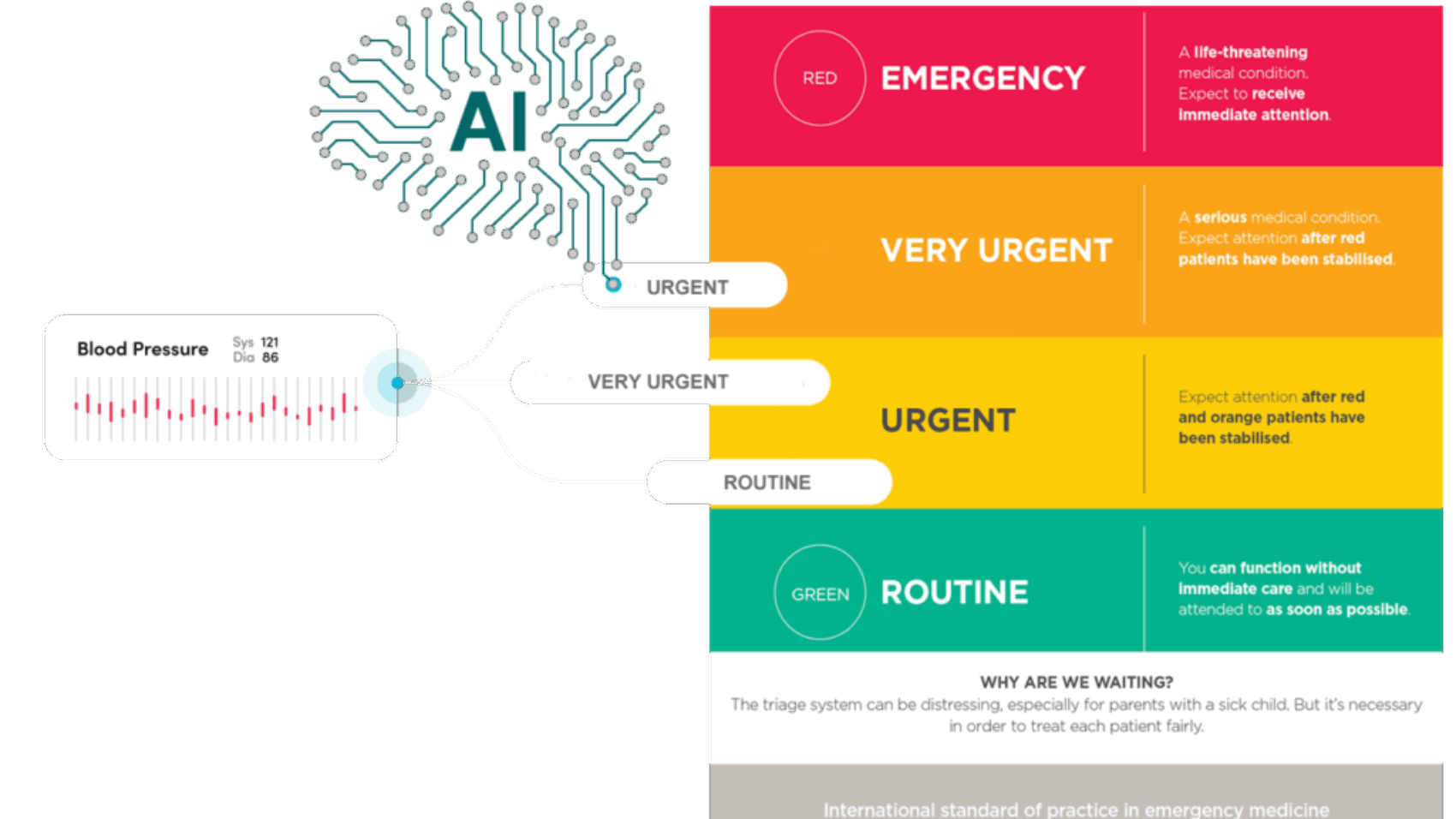
The AI Triage by Carepoi revolutionizes the patient care process by integrating AI technology to manage triage efficiently. This system allows patients to self-triage at various Points of Interest (POI), whether in a hospital, clinic, or at home. It reduces waiting times, enhances decision-making accuracy, and frees up healthcare staff from administrative tasks. By analyzing patient data in real-time, it ensures quick and accurate triage, enabling healthcare professionals to focus on critical care. AI-driven predictions improve patient flow and streamline emergency management, promoting faster and better healthcare delivery.

What is AI Triage?

AI Triage is a cutting-edge system designed to automate and streamline the triage process in healthcare. By leveraging advanced artificial intelligence, it allows patients to assess their symptoms and medical history, receiving instant guidance on the next steps in their care. This can include referrals, video consultations, or scheduling in-person and telehealth appointments. Integrated into one platform, AI Triage ensures swift, accurate decision-making, improving access to appropriate care while reducing administrative strain on healthcare professionals. This seamless technology is available for use across various healthcare settings, enhancing both patient experience and operational efficiency.

The Key Components of AI Triage

The AI Triage system consists of two primary components that work in tandem to enhance both the patient and clinician experience:

1) Unattended AI Triage

Unattended AI Triage by Carepoi operates autonomously, processing referrals through an API interface. The system evaluates urgency and makes predictions, such as recommending tests or scheduling follow-ups. If the referral meets automation criteria, AI Triage can automatically trigger next steps, like forwarding the referral to the booking team for further action. This reduces human intervention and speeds up the triage process.

2) Attended Virtual Assistant

The Attended Virtual Assistant (VA) aids clinicians by automating routine tasks like communicating with general practitioners for tests or advice. This allows healthcare providers to focus on more complex patient needs while the VA handles administrative duties. By streamlining these processes, the system improves efficiency and reduces clinician workload, making care delivery faster and more effective.

The Impact of AI Triage

The implementation of AI Triage in healthcare settings has had a profound impact, driving improvements in several key areas:

Faster Triage Process

AI Triage can complete a triage evaluation in just a few seconds, a significant improvement over the traditional method, which can take clinicians 4 to 5 minutes. This speed ensures that patients can be assessed and directed to the appropriate care without delay, reducing wait times and improving overall efficiency.

Reduction in Variability

By relying on AI algorithms trained on large volumes of historical data, the system significantly reduces unwarranted variations in triage decision-making. This consistency leads to more predictable and reliable outcomes for patients, minimizing the risk of errors or misclassifications that can sometimes occur with human judgment.

Lower Administrative Burden

Healthcare providers often struggle with administrative overload, which can lead to clinician burnout. AI Triage alleviates this burden by automating routine tasks, such as processing referrals and generating recommendations. This reduces the time clinicians spend on administrative work, enabling them to focus on patient care and decision-making.

Shorter Waiting Lists

The automation and efficiency provided by AI Triage actively manage the triage process, reducing waiting list times for patients. By quickly identifying those who require immediate attention and routing them to the right care pathway, the system ensures that patients are seen when they need to be, helping to prevent backlogs and reducing overall waiting times.

Facilitated Collaboration Across Care Levels

AI Triage fosters better collaboration between primary and secondary care providers. By delivering consistent and timely triage assessments, the system helps healthcare providers communicate more effectively and make coordinated decisions about patient care.

AI Triage in Action: Speed, Accuracy, and Availability

One of the standout features of the AI Triage by Carepoi is its speed, with predictions being made in mere seconds. This is especially important in emergency settings where timely intervention can be the difference between life and death. For comparison, while an experienced clinician might take several minutes to assess a patient, AI Triage completes the evaluation almost instantaneously.

Moreover, the system runs 24/7, meaning that patient referrals are processed immediately upon receipt, regardless of time of day. This round-the-clock availability ensures that patients never have to wait long for an initial assessment, even outside regular working hours.

AI Triage excels in accuracy, relying on large-scale historical data to ensure reliable performance. Trained extensively, it achieves a remarkable 97% accuracy rate in assessments. The system gathers over 50 clinical decision points, such as vital signs, test results, and symptom inputs. Advanced algorithms and certified triage protocols are applied to each case, enabling precise evaluation. This results in highly effective triaging, reducing the risk of error and ensuring patients receive appropriate care in a timely manner. This combination of accuracy and speed enhances the efficiency of the healthcare process.

Benefits for Patients and Healthcare Providers

AI Triage offers patients a fast, accurate, and accessible way to assess their symptoms and medical history, all from the comfort of their home or any other Point of Interest (POI). It connects patients with healthcare providers through video consultations or telehealth appointments, empowering them to manage their health. In emergencies, the system automatically directs them to the right care, such as urgent care or specialists, ensuring timely and appropriate treatment.

For healthcare providers, AI Triage significantly reduces the administrative burden of traditional triage processes. This allows clinicians to focus on delivering high-quality care. The system provides accurate, data-driven insights, enhancing decision-making and ensuring consistency. Moreover, by reducing waiting times, it improves efficiency and ensures that patients receive timely attention, ultimately streamlining the overall care delivery process.

Closing Thoughts

AI Triage is poised to revolutionize the way healthcare is delivered, offering patients a faster, more accurate, and more accessible way to triage their symptoms and connect with the appropriate care. By reducing administrative burdens, improving collaboration across care levels, and enhancing the overall efficiency of the healthcare system, AI Triage has the potential to greatly improve patient outcomes and transform the healthcare experience for both patients and providers alike. With its speed, accuracy, and 24/7 availability, AI Triage is a vital tool for the future of healthcare, ensuring that patients receive the right care at the right time.